
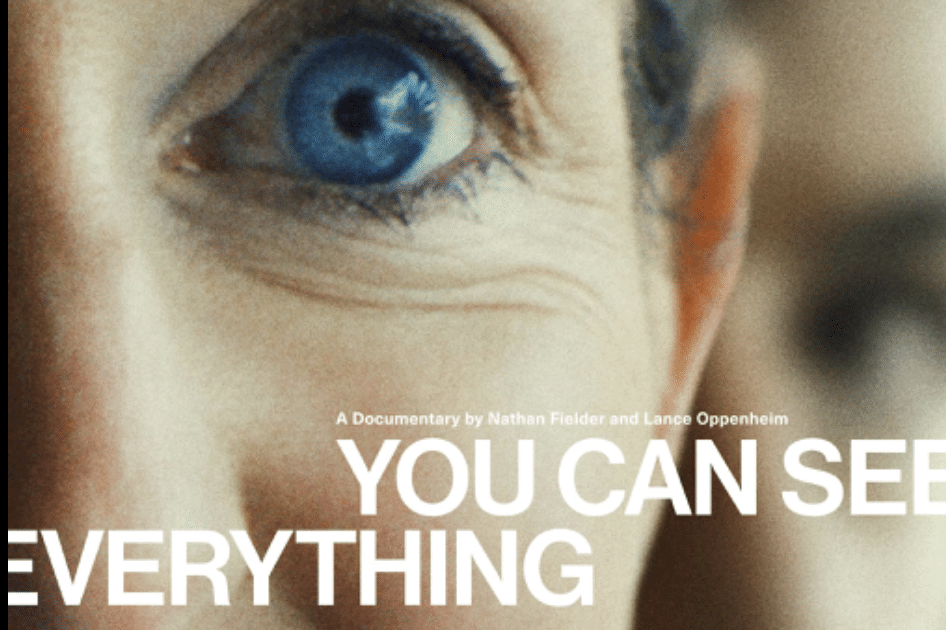
Photo courtesy of A24
Transparency item: A review provides an informed and opinionated critique. These informed critiques are published to make a recommendation to readers. This review is the opinion of the writer. Spoilers for “You Can See Everything” are mentioned in this article.
For a film titled “You Can See Everything,” the one thing viewers never quite see is the truth.
With a near-perfect Rotten Tomatoes score and overwhelmingly positive reviews on Letterboxd, the new A24 documentary “You Can See Everything” is a must-watch.
Co-directed by award-winning filmmakers Nathan Fielder and Lance Oppenheim, the documentary blurs the line between insanity and sympathy, leaving viewers confused, conflicted and deeply disturbed long after leaving the theater.
Although the film follows infamous Silicon Valley entrepreneur Elizabeth Holmes, the founder of the fraudulent blood-testing company Theranos, its true subject extends far beyond her criminal history. Instead, the film explores the complicated relationships between Holmes, her partner Billy Evans and Fielder himself.
What begins as an intimate portrait of a woman preparing for prison gradually evolves into a disturbing examination of manipulation, power and the destructive nature of toxic relationships.
The Illusion of Innocence
With only 34 days remaining before Holmes reports to federal prison, viewers are introduced to a mother of two facing the emotional turmoil of leaving her life behind. Despite her circumstances, Holmes appears surprisingly composed, soft-spoken and even lighthearted.
Viewers may begin to feel as if the documentary is going to offer a more humanizing perspective of Holmes — perhaps one that acknowledges her wrongdoings while reminding audiences that a person exists behind the scandal.
The film also introduces Evans, who initially appears to be a devoted and compassionate partner.
In one of the opening scenes, Holmes prepares eggs for her family before Evans gently takes the bowl from her and continues making breakfast himself. He explains that he wants to relieve some of the pressure his partner is experiencing before her imprisonment.
At first glance, the gesture seems innocent, even loving.
What initially looks like an act of kindness eventually becomes a symbol of something far more disturbing: control.
A Melting Pot of Manipulation
There is no shortage of deception throughout “You Can See Everything.”
During the film, Fielder asks Holmes a series of uncomfortable and often confrontational questions about her role in the Theranos scandal. Despite the gravity of his inquiries, Holmes repeatedly responds with confusion, vague explanations and a slight grin.
Perhaps her most captivating characteristic is her signature piercing gaze. Holmes maintains intense eye contact with Fielder throughout their conversations, creating an almost hypnotic connection between the two.
Evans only distorts Holmes’ reality.
What originally appeared to be a protective partner actually resembles someone more concerned with controlling Holmes’ public image and capitalizing on her notoriety.
Suddenly, the opening scene involving the eggs carries a much heavier meaning. Evans’ desire to take control of something as insignificant as preparing breakfast foreshadows his willingness to make much larger decisions on Holmes’ behalf.
The irony is that both individuals appear to manipulate one another.
Holmes has seemingly convinced Evans of her innocence, while Evans has become so invested in her narrative that he begins exercising control over the very person he claims to protect.
Yet, perhaps the most unsettling aspect of their relationship is that their love appears genuine. They seem to understand one another in a way that few others could.
However, genuine love does not necessarily make a relationship healthy.
Their relationship demonstrates how love, when intertwined with unhealthy behavior, can become something deeply destructive.
Amanda Seyfried is the Missing Piece
One of the film’s most ingenious creative decisions is the introduction of Amanda Seyfried, the Emmy-winning actress who previously portrayed Holmes in Hulu’s “The Dropout.”
Seyfried’s involvement offers a creative solution to one of Fielder’s biggest challenges: How can he continue documenting Holmes’ story when his subject is now behind bars?
Seyfried becomes the solution.
She reenacts conversations and interprets Holmes’ behavior, providing a visual representation. However, her contribution extends far beyond her acting abilities.
Seyfried is the documentary’s unlikely detective.
Her ability to interpret human behavior adds a layer of psychological complexity that the original footage alone cannot provide. She also challenges Evans as his behavior becomes increasingly more deceptive.
What makes her inclusion particularly brilliant is the way it challenges the conventions of documentary filmmaking.
The result is an unsettling contradiction — a fictional portrayal of Holmes may provide more insight into her character than Holmes herself is willing to reveal.
The Eyes are the Window to the Soul
The film distinguishes itself through its unconventional cinematography, as its intimate close-up shots serve a purpose far beyond visual storytelling.
Cinematographer David Bolen deliberately frames his subjects at an unusually close distance, allowing their faces to occupy nearly the entire screen. This technique exposes a level of vulnerability that traditional framing might otherwise conceal.
By emphasizing the eyes as the focal point of each shot, Bolen allows viewers to observe even the slightest twitch, glance or shift in expression.
These subtle movements invite audiences to look beyond what the subjects are saying and question what they may be concealing. Every lingering gaze or nervous glance becomes another clue in deciphering who is being deceptive, who is withholding information and who may actually be telling the truth.
Can Fielder be Trusted?
Despite the film’s extraordinary storytelling, one question continued to linger throughout the final act: Can Fielder truly be trusted to tell Holmes’ story objectively?
What initially begins as a 34-day documentary chronicling the final weeks before Holmes’ imprisonment eventually evolves into a nearly three-year investigation.
Fielder’s continued involvement raises questions about whether his interest in Holmes remains purely professional.
As his relationship with Evans deteriorates, Fielder appears increasingly concerned with protecting Holmes from her partner’s influence.
The filmmaker who originally intended to expose Holmes’ deception gradually begins to view her as someone who may need protecting. In doing so, he risks becoming another person drawn into the very manipulation he set out to investigate.
Fielder does not simply document the psychological dynamics surrounding Holmes and Evans. He becomes part of them.
And perhaps that is the film’s greatest achievement.
Rather than providing definitive answers about who is manipulating whom, “You Can See Everything” forces viewers to question the credibility of everyone involved, including the person behind the camera.
By the end, the documentary feels less like an investigation into the Theranos scandal and more like an examination of how easily human beings can become entangled in one another’s distorted realities.
For nearly three hours, Fielder attempts to reveal the truth about Elizabeth Holmes.
Yet, after everything viewers witness, the film leaves behind an unsettling realization: Seeing everything does not necessarily mean understanding anything.
This story was copy edited by Haylie Ross.
_________________________________
Follow the Graphic on X: @PeppGraphic
Contact Alexa McGlathery via email: alexa.mcglathery@pepperdine.edu