
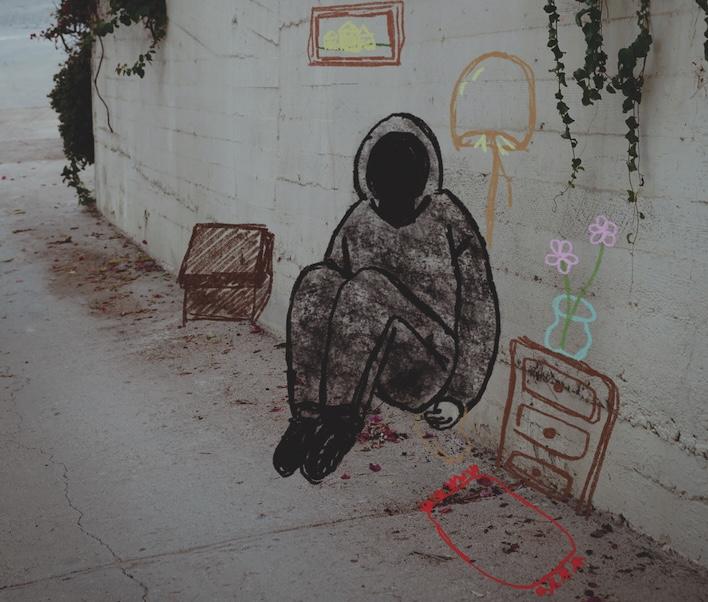
Art by Christine Park
Joseph Kling had just finished another day of high school. As a senior trying to push through his final year, Kling was exhausted after an entire day of class and cross country practice.
Wanting nothing more than to go home and lay his head down to rest, Kling began walking up to his Downey, California home. He slid his key in the door and grabbed the handle to push it open, ready to be greeted by the sweet smell of a home-cooked meal and the warmth of his family’s smiles.
Right when he tried to enter his house, he woke up in nothing but a brown Dickies jacket and the fierce cold of the outdoors. This nightmare was one that often scared Kling awake as he didn’t have a house to go home to — he was an unhoused teenager sleeping on the roofs of Walmarts and department stores in the Los Angeles area.
The United States is currently home to 771,480 unhoused people, according to the National Alliance to End Homelessness. Nearly 10% of these unhoused people, 72,308 of them, live in Los Angeles alone, according to the Los Angeles Homeless Services Authority.
“When you’re younger, home is where you lay your head, but for me, home became just belonging,” said Kling, 47, a current Long Beach resident who was unhoused for two years in the 90s. “It wasn’t belonging to everybody. It was just if you feel like that’s where you should be, that’s your home — whether it was a house, van, tent or the streets.”
Home Without a House
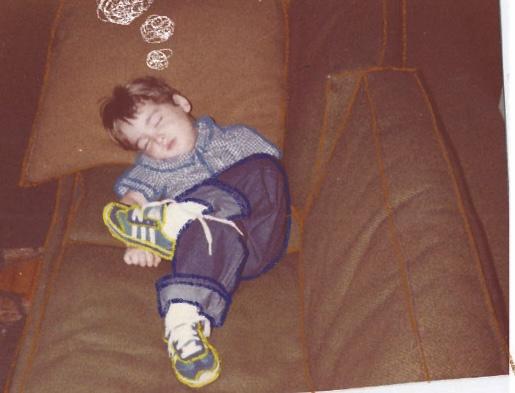
Long Beach resident Joseph Kling napping as a child on a sofa. Photo courtesy of Joseph King, illustration by Christine Park
Kling said he first lost his home as a senior in high school when he fell into the world of illegal substances and his family kicked him out.
“Pretty much, I just didn’t care,” Kling said. “I was going to high school with a Screwdriver or Vodka and orange juice in my water bottle. Eventually, it just became whatever was around that I could get my hands on.”
In an attempt to find something he could control, Kling lost himself in the process. To avoid feeling like an outcast, he used substances to find his home in what was around him.
“I was trying to fit in with something, and that was the easiest way to fit in with some people,” Kling said. “Contrary to a lot of people’s beliefs, alcoholics and drug addicts are pretty friendly people. As long as you got alcohol and drugs, everybody’s your friend, right?”
At this point, the world of substances became a place where Kling felt like he belonged. No matter what it was, Kling said he was able to find a community of people as long as he had something to exchange.
That sense of trade started defining Kling’s idea of home. Rather than thinking of home as a place he could put his head down, he started building his sense of home around the few possessions he had.
Kling said while living on the streets, he survived with a skateboard and backpack. While many unhoused people carry their belongings around with them, Kling didn’t find any reason to keep many material things.
“Whatever I was doing that day, that was home,” Kling said.
Building Bridges
Kay Gabbard, 82, regularly volunteers to feed the unhoused with Malibu United Methodist Church, working with Malibu Community Assistance Resource Team (CART). Several Malibu congregations — including Our Lady of Malibu Catholic Church, St. Aidan’s Episcopal Church, Chabad of Malibu and the Malibu Jewish Center and Synagogue — serve the hungry every Monday and Wednesday, and Pepperdine students often volunteer.
Gabbard said her efforts to help those in the city aren’t for any sort of exchange — they’re merely a sense of connection.
“I recognize there is a need in our city, specifically for those who are hungry,” Gabbard said. “There is a community counting on us — they’re looking to us for answers. I do it because I love it. I love these people.”
Michelle Woodall, a current unhoused person in the Los Angeles area, attended one of these community meals in Malibu in March. She said her sense of home lies in the connections she makes, whether those are with other people or her belief in God.
“Home means people, it means my daughters, but it also requires trusting God,” Woodall said. “It’s not up to anybody on Earth, we’re just sent here, but no one’s unstoppable. God has the final say.”
As an unhoused person in Los Angeles, Kling said he was often treated inhumanely. Even when someone would reach out to help him, he was skeptical. A lot of this doubt came from his experience trying to fit in on the streets.
Any time someone approached him, even if they were merely trying to give him food to eat, Kling put all of his walls up. He was instantly filled with questions, which led to one thing: What did this person want from him in exchange?
Woodall agreed about this skepticism controlling her life. Even as she interacts with different people daily, there are some words that constantly ring in her head as she continues searching for her version of home.
“Someone once told me, ‘Everything you know is a lie,’ and I’m realizing that’s true,” Woodall said. “I’m human too, just like anybody else. I haven’t lived a perfect life, but there’s still life that needs to be lived.”
This constant state of alarm changed how Kling thought of home. At his lowest, Kling said his care for life ceased to exist — he figured he would be dead within a few weeks anyways.
Kling never thought he would find a traditional sense of home again. He grew suspicious of everything, unable to find comfort anywhere or with anybody.
“I didn’t think that home was an option anymore,” Kling said.
This distrust is common in the “unhoused neighbors” Gabbard sees weekly. In fact, that is what fuels her outreach. Every week, Gabbard hands out meals to the local unhoused community.
Even when it’s raining or a busy day for her, such as Thanksgiving, Gabbard said she will always show up to distribute food. In this way, she is able to build trust with the unhoused — a sense of connection everyone needs.
“Many of them, in their perception, have been messed with their whole life and they don’t trust people, but if we can get together and trust each other — that is just one step,” Gabbard said.
While this was Kling’s experience on the streets, he clarified that not every unhoused person is the same. He said some stereotypes may apply to those who are unhoused, but not all have the same experience.
“For a while, there was a joke that I was one of the best-fed homeless people in the world,” Kling said. “I created a cycle of staying on couches, getting a homemade dinner, then I would be on a roof living out of a trash bag.”
Gabbard said one of the most valuable parts about connecting with the unhoused is hearing their stories. While some people tend to forget those on the streets are human beings too, it is something Gabbard holds close to her heart. Remembering this and treating the unhoused as the individuals they are is just another step in building trust.
“They’re just like us,” Gabbard said. “They’re all different, they all have their stories.”
The Search for Stability
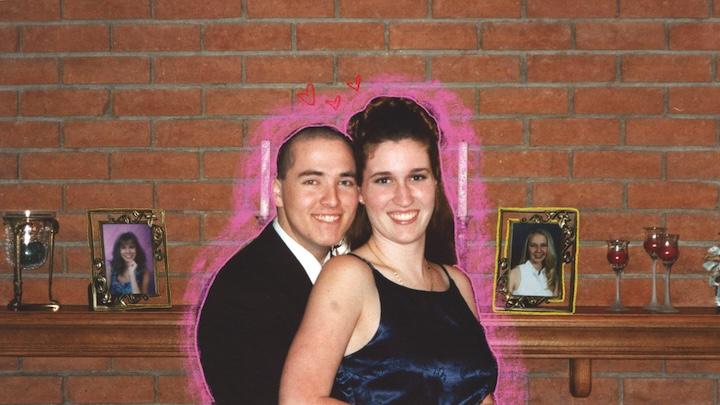
Kling and his wife, Jayna, who became a constant safe harbor for him. Photo courtesy Joseph King, illustration by Christine Park
While living a life of instability, searching for a place to sleep each night, Kling said he always appreciated those who reached out to him. Years after getting off the streets, Kling still has mementos he was given during that low point.
“I have a lot of crap now, but I can get rid of it and it really wouldn’t matter,” Kling said. “But those are things I would never give up, no matter what the situation is.”
Consistency is another thing Gabbard said is useful in building trust with the unhoused. While bouncing from place to place as an unhoused teen, Kling said his hope for consistency was what motivated him to keep moving forward.
“I always wanted a place that was mine,” Kling said. “I didn’t have a picture or an idea of what that place was. I just wanted a place that was regular — it didn’t matter what it was — just some place I knew that I could go that was nobody else’s, just mine.”
However, there were also some strings attached to his search for stability. For Kling, homelessness wasn’t necessarily the only option, it was a choice he made himself.
“I didn’t want to be a member of society, it was a way to escape,” Kling said. “Home was work, in fact it was too much work. Home was something I had to put effort into. So for a while, the idea of home was a real pain in the ass.”
Kling’s definition of home changed when he met his wife, Jayna, on Christmas Day in 1997. Two weeks after first meeting her, Jayna called Kling and told him to come live in her family’s house instead of continuing to move around.
“She saved my life,” Kling said. “She made me want to be better. There were no restrictions with her. She didn’t try to change me, she didn’t try to force me to do anything. She just was there.”
Jayna moved Kling into her family’s home while she started helping him get on his own two feet. What first started as a couch surfing spot became a place where he was able to start over. Little things, such as chores around the house, turned into building hygiene habits and finding a job he was passionate about: photography.
“She helped me slowly integrate back into being a regular person,” Kling said.
Kling’s definition of home wasn’t the only thing that changed once he got off the streets. He said his time being unhoused led to a change in how he viewed the world too.
“I see the world for what it is now,” Kling said. “Not everybody needs to have the same things or the same level of success. You define your own happiness. Whatever makes you happy and enjoyable, do it.”
Even though it has been nearly 30 years since Kling was on the streets, he said his time spent there still affects his life. What started as a fight for survival turned into a fight for a place in society.
“Home, for me, is still about being accepted,” Kling said. “I think I still fight for a little bit of acceptance.”
Home doesn’t have to be a place, home can be wherever someone feels most comfortable. When living on the streets, home became any place Kling could go and still feel welcomed.
“If you’re not welcome, that’s not really home,” Kling said. “Home is where you feel like you belong in a wider view.”
For the unhoused people in Malibu, they said their home is based on those who still remember they are human beings living life. Gabbard said this is what motivates her to help in any way she can.
“There’s nothing to me that’s more important than for them to feel like they’re being heard — they’re visible,” Gabbard said. “To me, that’s what we all need, not just them. We all need to feel seen and heard.”
_________________________________
Follow Currents Magazine on Twitter: @PeppCurrents and Instagram: @currentsmagazine
Contact Nina Fife via X: (@ninafife_) or by email: nina.fife@pepperdine.edu