
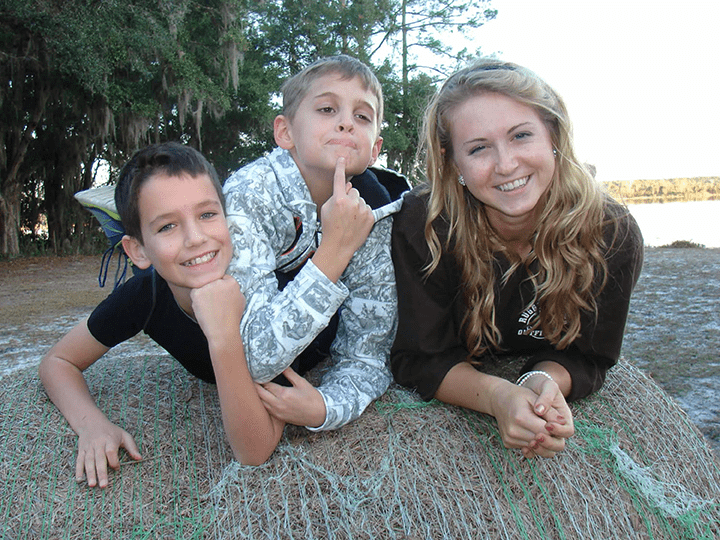
Luke Lewandowski (middle) poses with his adopted mother and brother. Photo courtesy of Luke Lewandowski
For some, the age of 18 brings the realities of adulthood and new bounds of freedom.
For senior Luke Lewandowski, this milestone involved a unique blood ritual.
“When everyone turned 18 in our family, we poked holes in all of our fingers and put the fingers against everyone so we had, like, the same blood,” Lewandowski said. “That was something my dad really wanted to do.”
Growing up in a family of three adopted children — and being one himself — his family always challenged the notion that they needed to share biology. In the absence of mirrored physical traits and shared cells, the bond of his family did not dissipate or atrophy, but rather grew into something thicker and deeper than DNA.
Lewandowski, fellow Pepperdine students Sofia Szykowny and Sydney Brennan and faculty member Zachary Luben discussed how their adoption stories challenged them and invited a new concept of family.
Finding Identity, Creating Identity
Born in South Korea and adopted at 8 months, Student Convocation Director Zachary Luben remembers the experiences that defined his identity and perception of family as he grew up. He can recognize the peculiarity in having two white parents, a white older brother and two adopted Asian siblings, while growing up in the Bay Area.
“Where I was, there wasn’t a lot of families who looked like mine,” Luben said.
Luben pointed to a specific moment of recognition that many adoptees experience and has been defined by certain scholars as the idea of “coming to consciousness,” in particular moments and spaces.
“You kind of begin to recognize that, you know, you don’t fit what a lot of people will assume when we use the word ‘family,’” Luben said.
First-year Sofia Szykowny recounted a similar experience, having been adopted into a Mexican-Polish family from Guatemala at 13 months old.
“Whenever I’m with my middle brother sometimes, they would just ask, like, ‘Oh, you guys are siblings? I didn’t know that,’” Szykowny said. “Some people don’t like to ask, ‘Oh, are you adopted?’ I would rather you tell me that than have assumptions or just to be weird about it ’cause it’s nothing to hide.”
Adoptee scholars have referenced the need for an adoptee to explain their existence in their family to others as a “narrative burden,” Luben said.
“So you think about going out to a dinner, sitting down, my parents are there, my older brother’s there, and then there’s these three Asian kids with this white family,” Luben said. “And your server is sort of like, ‘What are the dynamics? Are you a family?’”
Other adoptees feel they better match their family’s biological traits.
“A lot of people say that I look like my family,” Lewandowski said. “Everyone thought that I was just born to my parents, like when I had to explain to people that I was adopted more often than vice versa.”
Lewandowski’s adoption story began before he was even born — his adoptive parents were there at the hospital with his 16-year-old birth mother, and from that moment on they raised him as their own. Still, Lewandowski noted the challenge of adoption in struggling to form identity without the luxury of knowing his full heritage.
“I just know what she [his biological mom] looks like, and I know where she lives,” Lewandowski said. “Yeah, that’s kind of it. I know a little bit about my story and how the adoption process went for them, but I don’t know much about them as people.”
He’s shared one brief phone call with his biological mom. Lewandowski said he feels the need to search for identity in the moments where he disagrees with his adopted parents — begging the question of where, or even who, he may get a perspective from.
Part of Lewandowski believes it could just be growing into his own opinion and understanding the world better, but he acknowledged that he could have received these internal traits from his birth parents.
“I wish I knew,” Lewandowski said.
An all-encompassing, soul-searching quest for answers can then emerge for many who share this genetic disconnect.
“It’s like I had three sets of different families,” Szykowny said.
Placed in foster care before she was officially adopted, Szykowny recognizes her origin story as unique, creating curiosity over whether a part of herself remains in some of her original family.
Exploring Their Home Culture
Similar to the biological disconnect, a racial or ethnic disconnect can emerge for many transnational adoptees.
Walking around a department store, mother and child together, a woman — a stranger — approached Luben’s adopted mother with an accusation.
“She accused her of having kidnapped me,” Luben said.
Senior Sydney Brennan, a transracial and transnational adoptee, experienced similar challenges growing up Chinese in a white family.
“I feel like I made my own identity as adopted Chinese,” Brennan said. “I feel like that’s its own category because I don’t fully claim I’m Chinese — because I stick out with the Chinese people, but then, I’m not gonna say I’m white, you know?”
Brennan said that if she were to go back to China, she wouldn’t know how to act. Growing up, she felt a bit on the outside in Asian culture and considers herself whitewashed. Luben said he felt similarly.
“I don’t know, even to this day, I don’t know how comfortable I can say that I am being Asian, being Korean,” Luben said.
Luben remembers his mom trying to get him interested in Korean culture, but he simply did not want to, calling upon the childlike feeling of wanting to fit in. Now, he still struggles to dictate exactly how much this culture fits into his story and identity.
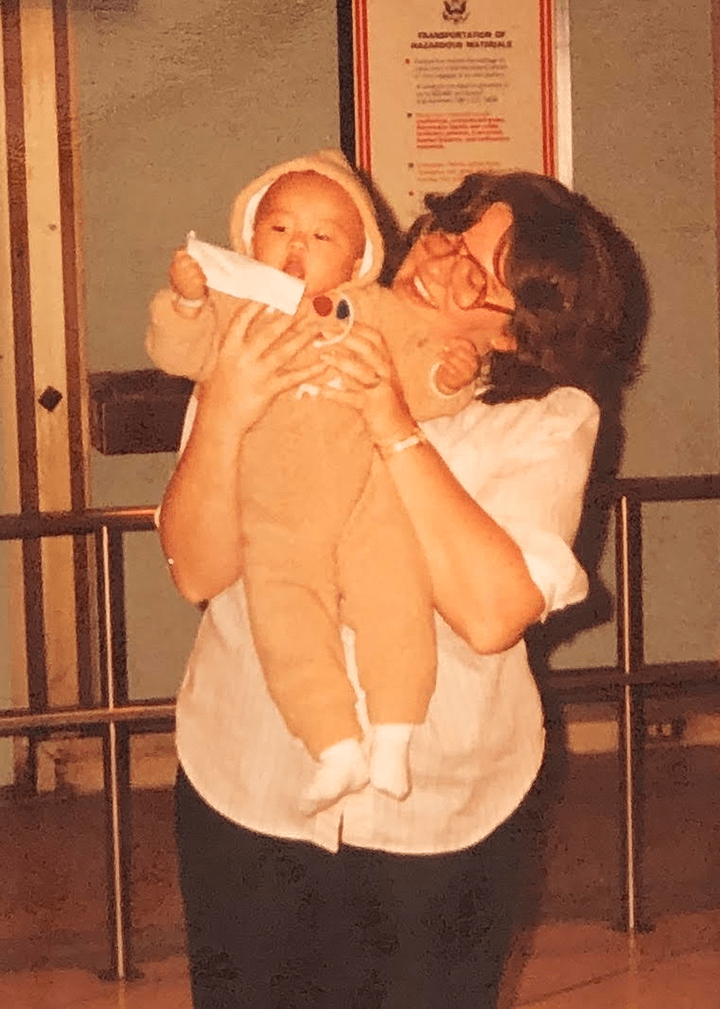
Zachary Luben is being held as a baby by his adopted mother. Photo courtesy of Zachary Luben
As he sees it, exploration of his “home culture” — Korean culture — has always felt a bit like doing a research project.
During the pandemic, Luben started cooking Korean food and evaluating it, but remembers thinking he didn’t really have a reference for it. He said he felt like an outsider to Korean culture who was trying to learn what it means.
“When I eat Korean food, it doesn’t remind me of a grandma or mom or anything like that,” Luben said. “It reminds me of the fact that I don’t have a context for it.”
A homemade meal and the taste of one’s home culture can carry weight for an adoptee, good and bad. For Szykowny, it was the taste of tamales.
Through her own efforts and the help of her church, Szykowny and her family once tried to find a Guatemalan refugee family in Chicago whom they could support. After a year of effort, she was successfully able to make a connection.
Szykowny and her family provided support for about two years, helping them buy groceries, facilitating their language learning, donating clothes and helping the family get settled in Chicago. In return, her family spent a lot of time over at their house and had the opportunity to make homemade tamales with them, which Szykowny said differed quite a bit from Mexican tamales.
“Being able to find family that at least looks almost exactly like me, and I’m able to try the food of our culture and get to know where they’re from and the language, was something very special that I’m really glad I was able to do,” Szykowny said.
A Lifelong Invitation
Like the intimate closeness and eternal existence of one’s own shadow, adoption will always be a part of an adoptee’s reality.
“I think that there are stages and seasons of life where you’ve made peace with it to a point, and you can put it down for a moment,” Luben said. “But then something will happen, and you might need to pick it back up.”
For Luben, this need came when his wife got pregnant. For others, it can look like attempting to find biological parents or visiting a home country.
Brennan said it might be uncomfortable or weird to find her birth parents, but also believes it would be great. She views this part of her life as something only God holds the answers to.
Similarly, Luben has considered going back to Korea and believes it could be something significant in helping him understand his story more. However, he also recognizes that the weight and expectation he has for a trip like that may just be too much.
Szykowny said she plans on revisiting Guatemala in her senior year or after she graduates.
“Whether it’s good or bad, I know to not have any expectations ’cause you never know what could happen or what it might entail,” Szykowny said. “I know some people also don’t want to ever go back and figure out their roots, but I’ve never had that mindset.”
Seeking a sense of belonging, many adoptees engage with these roots in celebration of their “Gotcha Day:” a day commemorating the day their parents officially adopted them.
“I love to celebrate it,” Szykowny said. “I find it [her Gotcha Day] more important than my birthday, and it’s just like celebrating my chance of life and having a meaning to it all.”
A dinner out, a small gift, a day of celebration — Luben recounted the joy of every Feb. 16, his “Special Day.” Celebrating with his family growing up, he now carries on the tradition with his wife and son to commemorate his story.
Home Found in Family
“What I want more than anything as an adoptee is to be able to have to live in the ambiguity of the story,” Luben said. “It’s not all bad and it’s not all good. And a lot of times, for whatever reason, there’s this pressure to make it one or the other. And where I feel maybe most at home in talking about my story and my family is to recognize the full complexity.”
In navigating this shared complexity, Lewandowski said he can recognize pieces of himself that leave no doubt of his origin — he is his parents’ son, through and through.
“She’s [his adopted mom is] a big ‘I love you’ person, and that’s something that I inherited,” Lewandowski said. “It’s almost a form of like goodbye, like, ‘Bye, love you.’ I said that to my teacher the other day on accident — it was a really funny moment.”
Similar hair, similar eyes, similar smiles — the telltale signs of family, though valuable, all begin to fade into the background as evidence of similar hearts and souls rises to the surface.
Brennan said she sees herself as blending in completely with her family even though physically she knows she does not.
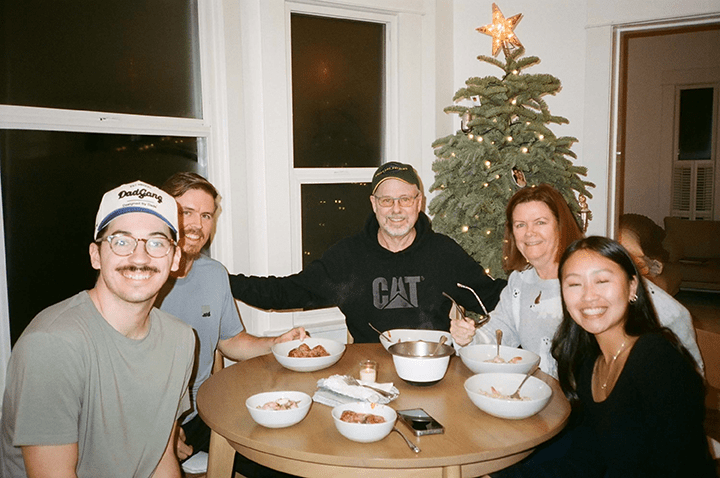
Sydney Brennan (right) shares a meal with her immediate family and brother-in-law. Photo courtesy of Sydney Brennan
Defining family as one grows up, the life of an adoptee hinges on the relationships formed with their chosen family, finding home and identity in each other. Szykowny said she cherishes growing up with her brothers and recognizes how both of their personalities make up who she is.
“I’m half of them, they are half of me,” Szykowny said.
Lewandowski recounted a similar sentiment, growing up with brothers adopted from all different parts of Colorado and with vastly different features.
“My brothers are my brothers, even though we’re not related,” Lewandowski said. “‘Biological’ — it’s a cool phrase, but it’s not that important.”
Adoptees have found significance in the people who found and chose them, ultimately drawing upon something deeper than mere flesh and blood.
“Do you want a different child?” Szykowny remembers a story from her parents in which the adoption agency offered them another child after running into some legal issues during the year-long process of acquiring Szykowny specifically.
“No, we don’t want that happening. We’re gonna have the child that we want, that we were given,” Szykowny’s parents replied.
Szykowny believes she owes everything, from now until forever, to her parents — without them, she would never be where she is today, she said.
“They say ‘home is where the heart is.’ And I know that’s kind of cliche, but I agree with that — it’s where your family is,” Brennan said. “Family, meaning for me — my family is a little different. But I still consider them fully my family, people who raised me, and I think it’s more special that they chose me.”
___________________
Follow Currents Magazine on X: @PeppCurrents and Instagram: @currentsmagazine
Contact Lila Rendel via email: lila.rendel@pepperdine.edu