
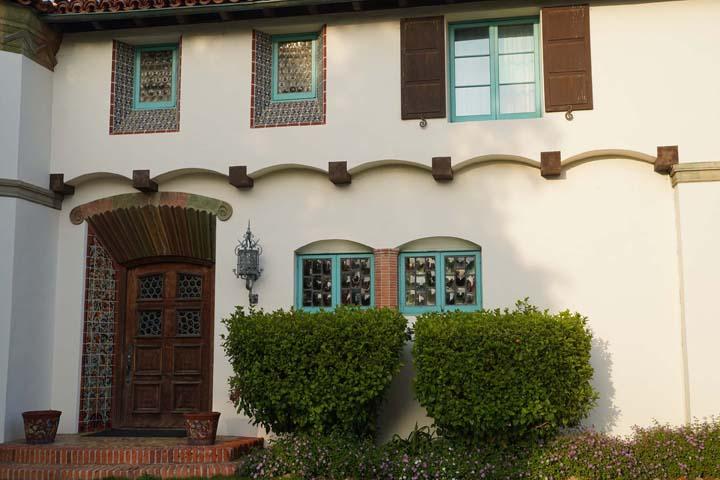
Sunlight falls on the front of the Adamson House March 21. The Adamsons wanted this house to be a showcase of their tile, Docent Norman Buehring said.
Steps away from the Malibu Lagoon, where the bright blue waves lap against a sandy shore and seabirds circle overhead, stands the home that marks the beginning of Malibu’s history.
The Adamson House can be easy to miss along Pacific Coast Highway. The home is tucked behind a Spanish-style gate and peppertrees, with a tiled sign announcing its presence: “ADAMSON HOUSE, Discover Historic Malibu.”
Long before Malibu became synonymous with oceanfront mansions and celebrity sightings, the land belonged almost entirely to one family.
Rindge’s History
“So the real family is not Adamson,” said 83-year-old docent Norman Buehring, who has volunteered at the house for more than two decades. “It’s the Rindge family.”
In 1892, Frederick Rindge purchased 13,000 acres and 20 miles of coastline stretching along the Pacific, Buehring said. At the time, Malibu was largely undeveloped. Rindge, a businessman and lawyer, thought it was the perfect place to build his estate.
“They were Malibu,” Buehring said. “Owned it all.”
As California expanded, the state began to seek passage through the Rindge’s land. Frederick and his wife May fought off railroad companies hoping to run tracks along the coast. They continued their legal battle with the state for years over plans to build a highway through their property, now known as Pacific Coast Highway.
However, the cost of the legal battles eventually took its toll. By the 1930s, the family faced bankruptcy. Buehring said much of their land was sold off, opening the door for the development that followed.
What remained was the Adamson House.
Built in 1929 by Frederick Rindge’s daughter, Rhoda Rindge Adamson, and her husband, Merritt Adamson, the home was originally intended as a beach house. Now, it serves as a time capsule for the modern developers of Malibu.
Impact Today
For Buehring, that authenticity is what makes the house so meaningful.
“What this is — this house — it’s Malibu’s history,” Buehring said. “There’s nothing else like it here.”
“It’s a jewel of Malibu,” Calabasas native Nina Johnson said. “It’s probably one of the most beautiful time capsules I’ve ever seen.”
Johnson was struck by the house’s beauty and the care that went into its design.
“It reflects the culture of the time and the people that had the vision to build it,” Johnson said. “They took such great care and put so much love and personality into it.”
Each room holds its own artistic personality, from sailboat tile on the youngest son’s bedroom walls to hand-painted birds on the nanny’s bedroom ceiling.
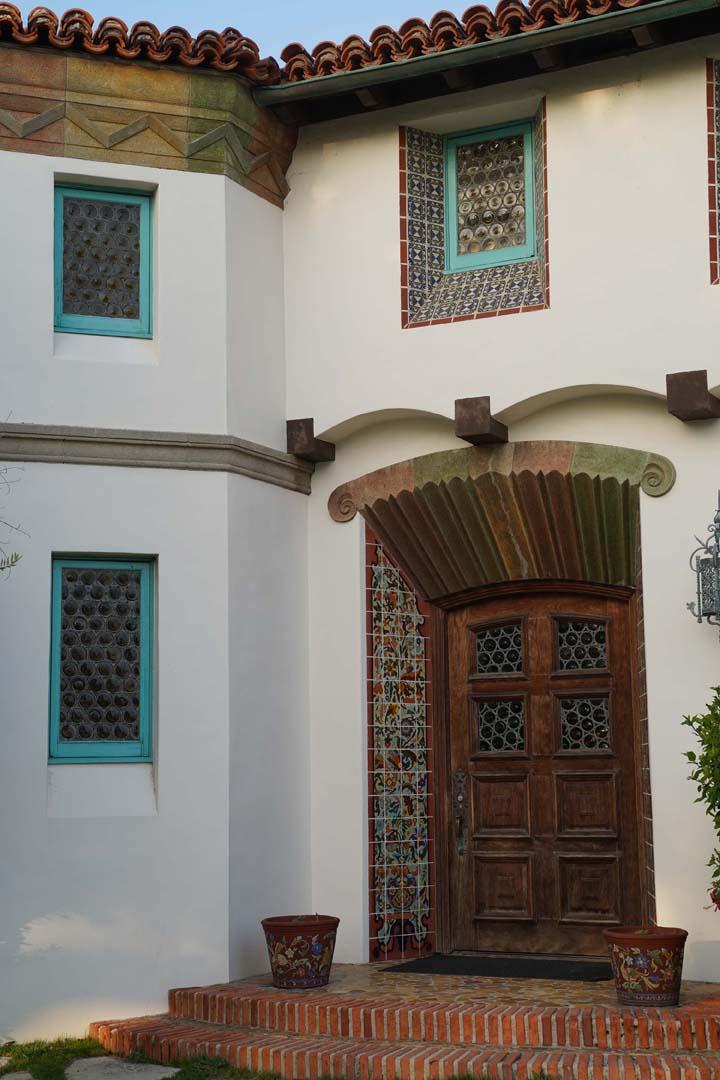
Sunlight falls on the front of the Adamson House March 21. The Adamsons wanted this house to be a showcase of their tile, Buehring said.
Connections to Pepperdine
The Adamson House also carries another layer of meaning for Pepperdine. Toward the end of their legal battles, the Rindge family donated 138 acres to help relocate Pepperdine University from South Los Angeles to its current hillside campus overlooking the ocean, Buehring said. Furthermore, Chancellor M. Norvel Young moved into the Adamson House in 1971, maintaining the home until it could be properly restored, according to the Adamson House website.
History Professor Megan Kendrick said the connection makes the house an important part of local history for students.
“It’s fun for me to be able to show students this aspect of local history because it has had such a direct link to the existence of our campus,” Kendrick said. “The family had such an outsized impact on the creation of Malibu as we know it.”
For some visitors, the experience of walking through the house feels even more personal.
The house reminded 89-year-old visitor Kenny Joy Rizzo of the place where she grew up.
“The moment I stepped inside, it reminded me of my home my father built in Burbank,” Rizzo said. “The bottles in the kitchen are the same bottles that would be delivered to my family.”
Those small details make the Adamson house feel less like a museum and more like a home, Rizzo said.
The grounds are open to explore for free every day from 8 a.m. to sunset. To take a guided tour of the inside of the home, visitors are welcome from Wednesday to Saturday, 11 a.m. to 2 p.m., for $7.
_________________________________
Follow Currents Magazine on X: @PeppCurrents and Instagram: @currentsmagazine
Contact Cristal Soto via email: cristal.soto@pepperdine.edu