

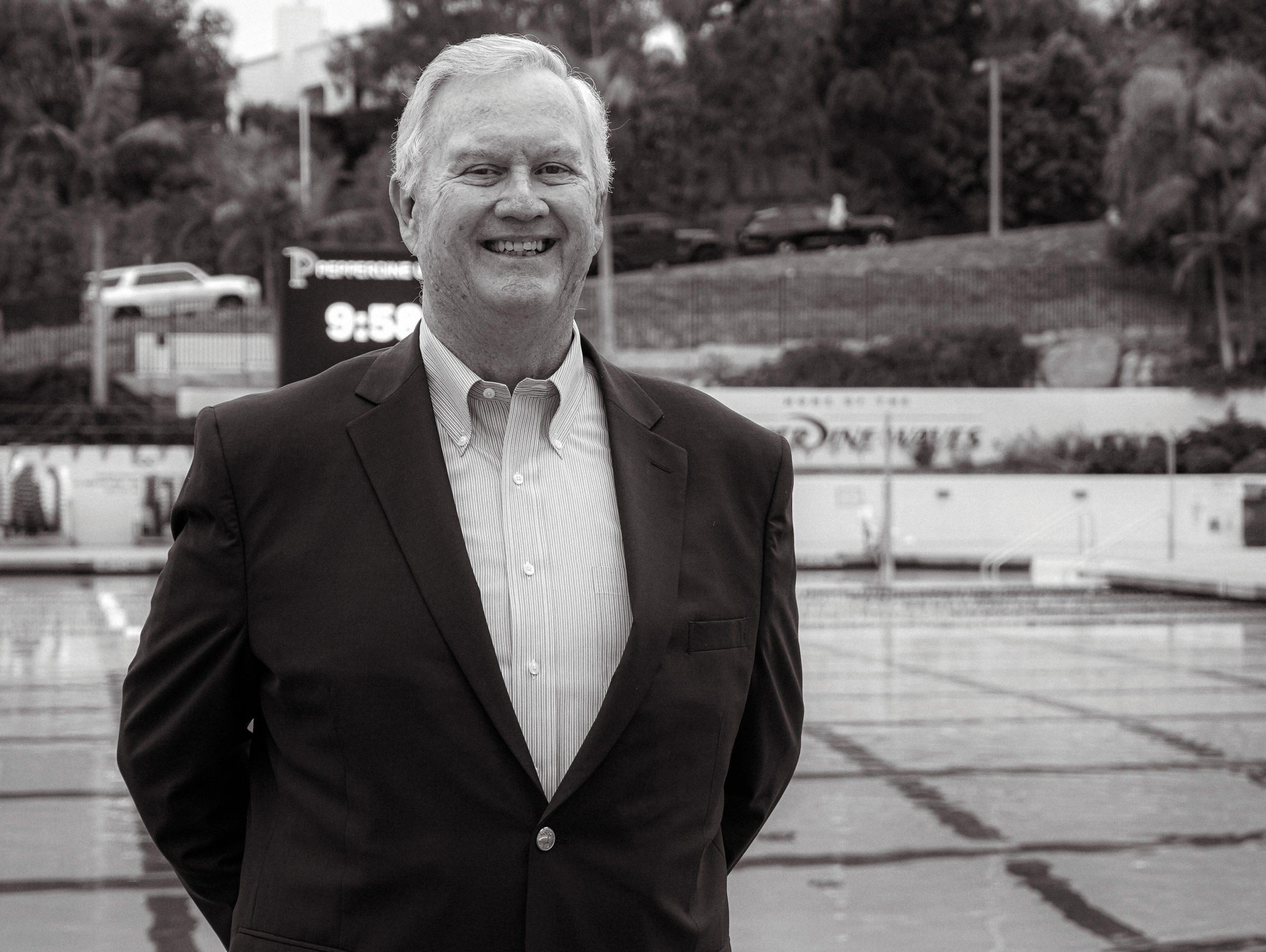
Photo by Betsy Burrow
Through his over 50-year career at Pepperdine, John Watson, founder of the Sport Administration program, has seen massive changes. He’s worked under five presidents, was a part of the shift from the Los Angeles campus to the Malibu campus and saw the Malibu campus grow into what it is today, among several other changes.
Watson originally joined Pepperdine full time in 1973 and joined the Seaver faculty full time in 1992. Throughout his tenure, he said he has held numerous roles such as director of Athletics, director of Business Services, vice president for Administration and faculty athletic representative to the NCAA, among others.
“It’s been the right place for me, and they’ve been gracious enough to allow me to have a variety of experiences,” Watson said.
Before he began working at Pepperdine, Watson studied at California State University, Long Beach before he was drafted into the Army. Afterward, Watson finished his bachelor’s degree in Political Science at Pepperdine when the campus was still in LA. He then went on to earn his master’s degree in Teaching from Pepperdine in 1975 and doctorate of Education from UCLA in 1984.
Watson said he realized Pepperdine was the place for him after arriving at the original LA campus due to the difference in environment between Pepperdine and the Army.
“People on [the LA] campus, whether they knew you or not, greeted you, looked you in the eye,” Watson said. “You felt welcomed and appreciated. There was no more drinking, cussing and all that other stuff, and I said, ‘This is what I want in my life.’”
When Pepperdine first moved to Malibu, Watson said the campus and city he saw were vastly different from what students see today. All of the administration was on the top floor of the library, except for the payroll office, which was in a trailer in a parking lot. The Country Mart was a single grocery store, and the area around Ralphs was just a single restaurant called “The Greasy Spoon” and a field.
Watson said he saw the University struggle financially after first moving to Malibu, as Pepperdine had to ask employees to go a month without a paycheck. Despite the struggles, the leadership persisted forward.
“I saw this on the cusp of nonexistence and saw them be able to maneuver us to a place where we maintained our mission and also were able to survive,” Watson said.
During Watson’s time as director of Athletics, he saw the University win two national championships — Men’s Volleyball in 2005 and Men’s Tennis in 2006, according to Pepperdine Athletics.
While Watson was the director of Athletics, he said there were much heavier restrictions on the amount of athletes who could be given a scholarship. Men’s Volleyball could only offer four and a half scholarships, while some others — like Women’s Swim and Dive — didn’t offer any.
Watson said seeing so many athletes pay to be at Pepperdine but still give their all competing made him equally as proud as the two national championships did.
“It was our duty to be certain they had the quality experience because they were investing their time in supporting us and representing us,” Watson said.
When the 1984 Olympics were held in LA, Pepperdine’s Raleigh Runnels Memorial Pool was the location of the Olympic water polo matches, said Marv Dunphy, Pepperdine Men’s Volleyball head coach emeritus.
Watson, along with then President Howard White, made that happen and brought Pepperdine massive amounts of publicity, Dunphy said.
“Of all the Olympic sports, this venue was the best, and John Watson put that together with the help of the president,” Dunphy said. “But again, not too many people know that, but everybody brags about having the most beautiful venue of all sports.”

Pepperdine hosts water polo during the 1984 Olympics. Watson helped organize Pepperdine getting to host the sport, which brought the school a lot of publicity. Photo courtesy of Pepperdine Libraries Digital Collections
Dunphy said Watson was always supporting the athletes on an individual level as well. Watson was present every day, arriving early in the morning, with an open-door policy in his office, always willing to listen to anything a student-athlete had to say.
After Watson finished his tenure as director of Athletics, he said he returned to the Seaver faculty in January 2011. When he was the director of Athletics, he saw many student-athletes choosing majors that fit their schedules instead of ones they wanted to pursue.
Watson created the Sport Administration major with the hope that the program would offer opportunities to students who were interested in athletics while also being academically rigorous. The new major began offering classes that blend Business and Communication with specific courses in sports in Fall 2014.
Watson’s open-door policy extended to his students in the new major, always willing to listen no matter the topic, said James O’Callaghan, senior Sport Administration major.
“I’ve gone and talked to him even when I haven’t been in a class with him that semester, and he’s always there to talk,” O’Callaghan said.
The opportunity to develop students into strong leaders, along with Pepperdine’s mission, has kept Watson at the University all this time, he said.
“When they write the history of Pepperdine University, I don’t know if he would be on the cover,” Dunphy said. “But for me, [he’s] chapter one, two, three because he knows, and he’s given so much to this University in so many different roles.”
__________________________________________________
Follow Currents Magazine on X: @PeppCurrents and Instagram: @currentsmagazine
Contact Tony Gleason on X (@tony__gleason) or via email: anthony.gleason@pepperdine.edu