
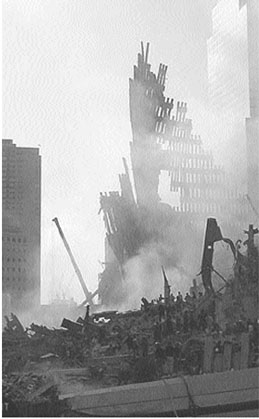
 8:45 a.m.
Hijacked American Airlines Flight 11 crashes into the north tower of the World Trade Center.
9:03 a.m.
Hijacked United Airlines Flight 175 chashes into the south tower of the World Trade Center
9:43 a.m.
American Airlines Flight 77 crashes into the Pentagon.
10:05 a.m.
The World Trade Center’s south tower collapses.
CASSEY LAMENSKY/STAFF PHOTOGRAPHER
10:10 a.m.
United Flight 93 crashes into Somerset County, Pa.
10:25 a.m.
The World Trade Center’s north tower collapses.
September 13, 2001
Osama bin Laden is identified as the prime suspect.
October 7, 2001
American and British forces conduct missile attacks on Taliban military targets and Osama bin Laden’s al-Qaida training camps in Afghanistan.
October 19, 2001
A U.S. helicopter crashes in Afghanistan, killing two people in the first combat-related American deaths in the War on Terror.
December 1, 2001
John Walker Lind, a U.S. citizen who traveled to Afghanistan six months before the attacks “to help the Islamic government” was captured by U.S. soldiers.
December 7, 2001
Afghanistan’s Taliban government collapses as their troops flee U.S. troops in Kandahar. Major fighting in Afghanistan doesn’t end until May 2002.
December 13, 2001
The Bush administration releases a videotape showing Osama bin Laden speaking about the Sept.11 attacks and how he was
pleased with the results.
January 29, 2002
In President Bush’s first State of the Union speech, he announces the War on Terror and calls the nations of Iran, Iraq and North Korea an “Axis of Evil.”
February 5, 2002
The Bush administration’s budget announces a $2.1 trillion plan for anti-terrorism efforts. The budget has the biggest defense percentage since 1966.
March 9, 2002
Bush administration directs the military to prepare nuclear weapons for use on several countries: China, Russia, Iraq, Iran, North Korea, Syria and Libya.
March 11, 2002
The six-month anniversary of the Sept. 11 attacks is marked in New York with the illumination of two columns of light located near Ground Zero.
April 18, 2002
A United States F-16 kills four Canadian soldiers and injures eight more when it mistakes a training excercise for hostile Taliban fire.
May 30, 2002
The recovery at Ground Zero officially ends. More than 1,600 people who died were never found.
August 5, 2002
Iraq invites the United States to send weapons inspectors to search for weapons of mass destruction. The U.S. government does not consider the offer to be serious.
September 11, 2002
On the first anniversary of the terrorist attacks, President Bush attends a ceremony at the now-cleared Ground Zero. A large ramp allowed victims’ families to place memorials in a circular area at the center of the attack site. The names of every victim in the attack is read by a list of locals including former mayor Rudolph Guiliani, Sen. Hillary Rodham Clinton and Gov. George Pataki.
October 16, 2002
North Korea admits to developing nuclear weapons despite U.N. treaty promising they would not.
November 8, 2002
The United Nations passes the unanimous Resolution 1441 calling on Iraq to disarm or else face “serious consequences.”
November 18, 2002
United Nations weapons inspectors return to Iraq.
December 7, 2002
Iraq submits a 12,000-page document showing its chemical, biological and nuclear capabilities. It claims Iraq has no illegal weapons.
December 21, 2002
President Bush deploys U.S. troops to the Persian Gulf region. An estimated 200,000 troops are scheduled to arrive by March. British and Australian forces will also join the military build-up.
January 27, 2003
The United Nations formal report on its Iraq inspections is released. Chief inspector Hans Blix said, “Iraq appears not to have come to a genuine acceptance, not even today, of the disarmament that was demanded of it.”
January 28, 2003
In his State of the Union address, President Bush declares he is prepared to attack Iraq without U.N. support. It’s in this speech that he makes false claims about Iraq obtaining chemical weapon materials from African nations. The CIA was later blamed for the information making its way into the speech.
February 22, 2003
Hans Blix orders Iraq to destroy its illegal Al Samoud 2 missiles by March 1. The U.N. inspectors have determined the missiles are capable of reaching outside the legal-range limit.
The United States, Britain and Spain submit a propsed resolution to the U.N. Security Council stating “Iraq has failed to take the final opportunity afforded to it in Resolution 1441,” and it is now time to authorize the use of military force against Iraq.
February 24, 2003
France, Germany and Russia submit a counter-resolution to the U.N. Security Council stating inspections should be extended and intensified to ensure that there is “a real chance to the peaceful settlement of this crisis,” and “the military option should only be a last resort.”
The U.S. and Britain’s efforts to win U.N. Security Council members last until March 14, yielding four supporters (in addition to Spain and Bulgaria); nine votes out of 15 are required, with no vetoes from the five permanent members, for it to pass. The U.S. decides not to call for a vote on the resolution.
March 17, 2003
President Bush delivers an ultimatum to Saddam Hussein to leave the country within 48 hours or face an attack. All diplomatic efforts cease.
 March 19, 2003
The United States launches Operation: Iraqi Freedom, starting the war against Iraq. The intial air strike, called a “decapitation attack” of “shock and awe” attempted to target Saddam Hussein and other Iraqi leaders in Baghdad.
April 9, 2003
Baghdad falls as U.S. forces take control of the city.
September 11, 2003
DANIEL JOHNSON/PHOTO EDITOR
September 11, 2003