
Design of the massive cathedral provides guidance for the faithful.
By Laurie Babinski
Art Editor
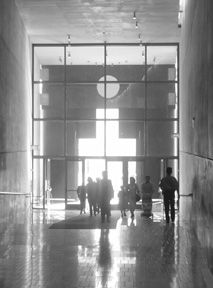 The pilgrimage begins with the river of laity and clerics streaming under the archway marked by a modern metal angel. They continue through the towering bronze church doors in the southeast side of the cathedral, doors that serve as a bridge over which followers may travel back and forth across the ages on their journey of faith.
Spanish architect José Rafael Moneo designed the massive 11-story cathedral to keep the river of faith flowing throughout the new flagship of the Archdioses of Los Angeles.
Students have taken advantage of the new facility, visiting it as a point of interest or as part of their faith. Both individual visits and organized visits through organizations such as the Catholic Student Association have sparked student interest.
“I think Los Angeles needed it … the money was worth it,” said junior econ major Snatiago Mazon, who visited the cathedral for mass during Advent. “Architecturally, it’s just beautiful.”
But student visits aren’t the only connection Pepperdine has with the landmark. The foundation of Pepperdine philanthropist Flora L. Thornton, namesake of the administration center and the university opera program, donated money toward construction of the awe-inspiring entryway reminiscent of those that lead into European cathedrals.
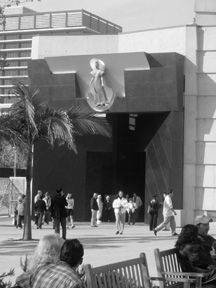 The building, surprisingly erected along the 101 Freeway in Los Angeles, captures the feeling of movement from the bronze door entrance to the basement mausoleum. The contemporary plans included virtually no right angles, a feature that guides visitors and parishioners alike through the entrance hall and toward the Spanish baroque retablo housed along the back wall. The retablo, crafted of 17th Century gilded, black walnut, is a shelf raised above the back of an altar to support ornaments, pictures and statues from sacred history.
Guided by 12 bronze and silver angel candle holders, crowds glide into the nave of the cathedral toward the baptismal font. Dwarfed by a profound tapestry of John baptizing Jesus, the fountain features abundant flowing water to commemorate the Christian sacrament where followers embrace the life and death of Jesus Christ.
Down the tapestry-lined limestone aisle and past hundreds of pews lies the heart of the church, the nave. The Cathedral’s 300-foot nave is the place of gathering. Fixed seating allows for 1,900 people and an additional 1,100 in moveable seating, for a total of 3,000 people, according to the cathedral’s Web site.
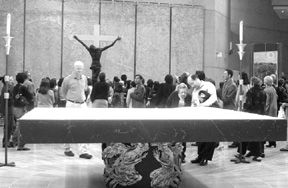
In the front of the cathedral lies the altar, which is constructed from a six-ton slab of Turkish Rosso Laguna marble. Fabricated, cut, polished and shipped from Carrara, Italy, it stands eight-feet wide, 10-feet across and 10-inches thick.
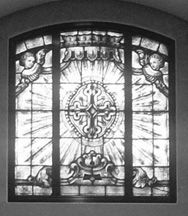 The Prayer of Blessing of the Altar highlights the Catholic understanding of the altar in worship: “May this altar be the place where the great mysteries of redemption are accomplished, a place where your people offer their gifts, unfold their good intentions, pour out their prayers, and echo every meaning of their faith and devotion.”
Somewhere above the altar is a laminated plaque placed on the underside of the cedar panels by the workers who built the ceiling. According to the Web site, it contains several Scripture verses, including Psalm 84:4-5: “As the sparrow finds a home and the swallow a nest to settle her young, my home is by your altars, Lord of hosts, my king and my God!’
In back of the altar lies a crucifix — the image of Jesus nailed to the cross. And if the heart of the church is the nave, the soul lies in the background to the right of the altar — a 85-foot tall pipe organ.
Beneath the altar, accessible via a staircase on the east end of the cathedral, lies the mausoleum and a chapel dedicated to Saint Vibiana. The crypt has 6,000 plots for both laity and clerics.
 This, the first Roman Catholic Cathedral to be erected in the Western United States in 30 years, began construction May 1999 and was completed by spring 2002.
A tour through the cathedral, which Southern Californians have been waiting decades for, remains a highly symbolic of the journey of faith. Even the outside, where the courtyard, gift shop and snack bar lie, is symbolic of the journey. The freeway, Moneo said, is like a river along which cathedrals in Europe are traditionally built, bringing the faithful and the curious to the cathedral.
Some stop and then are jettisoned back into the world, better equipped to handle the rigors of life. Others just pass by. But the cathedral remains there awaiting all who are willing to take the journey.
Hours of Operation
Monday-Friday
6:30 a.m. to 6 p.m. 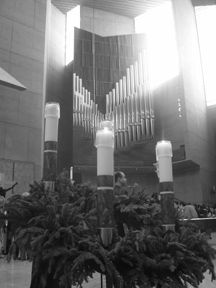
Saturday
9 a.m. to 5 p.m.
Sunday
7 a.m. to 5 p.m.
Mass Schedule
Monday-Friday
7 a.m., English
12:10 p.m., English
Sunday
8 a.m., English
10 a.m., English
12:30 p.m., Spanish
Directions
Take the 101 Hollywood Freeway south to downtown. Exit on Broadway and turn on Broadway, then right on Temple. After crossing Hill Street, turn right from Temple Street into the parking garage.
Parking
Parking rates vary depending on day, time and mass schedule.
February 06, 2003