

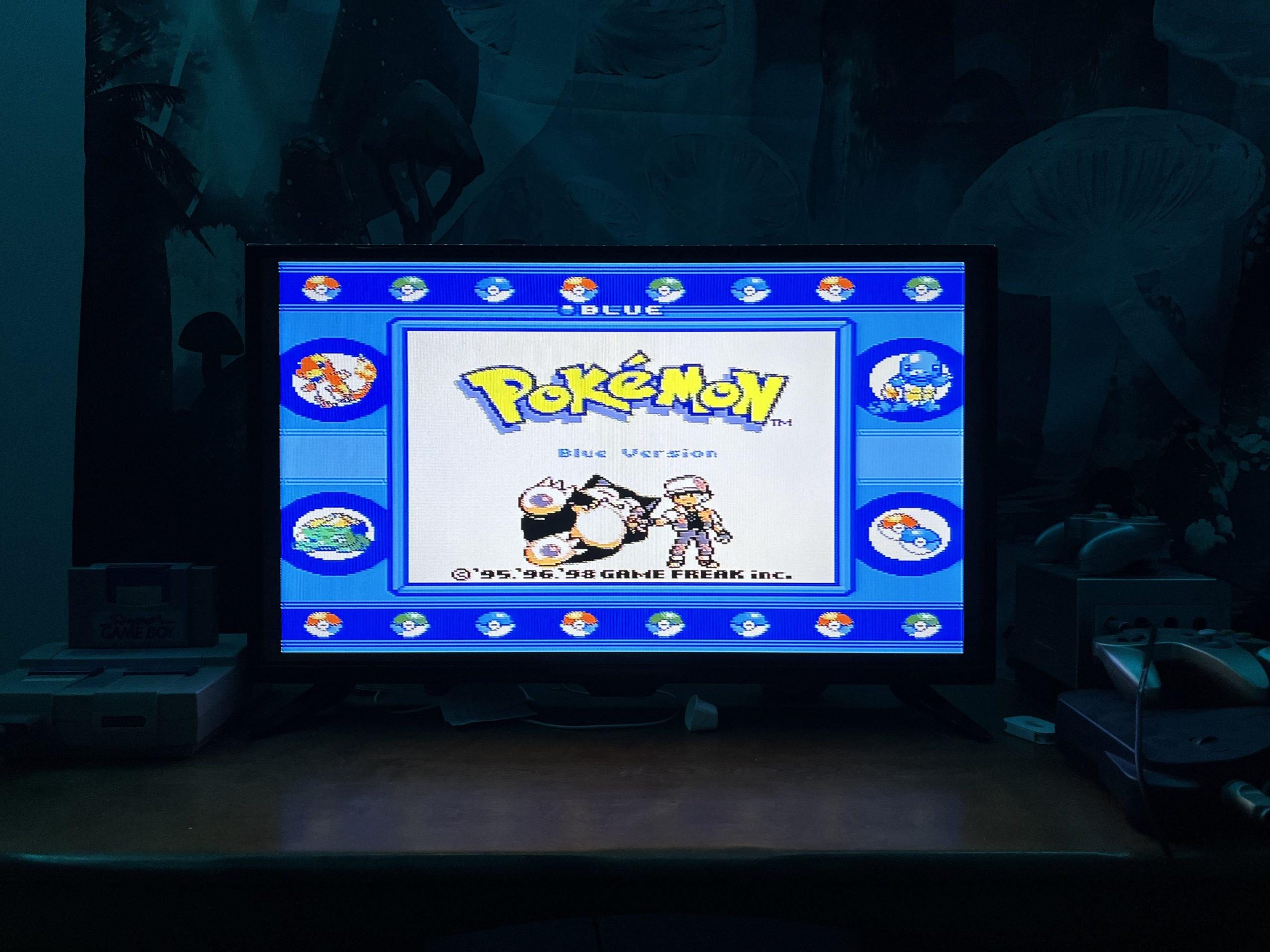
“Pokémon Blue” plays on a TV Feb. 27, 2024. The “Pokémon” series recently celebrated its 30th anniversary. Photo by Tony Gleason
For 30 years now, fans have been catching ‘em all in the “Pokémon” series of video games.
For the fans who wanted more though, they’ve had Pokémon YouTube to create content, which — just like the Pokémon themselves — has evolved.
Multiple “Pokémon” YouTubers (PokéTubers) said the PokéTube landscape has evolved over the years, each with their own trends and big name channels dominating the space. What was once barely a community, has grown into a massive subsection of YouTube.
“Now it’s so big that we’ve kind of almost gone back to where we started, where the “Pokémon” content creators are kind of in their own small section of the community, because there’s so much to cover,” said YouTuber Josh Wittenkeller, who runs the channel TheJWittz.
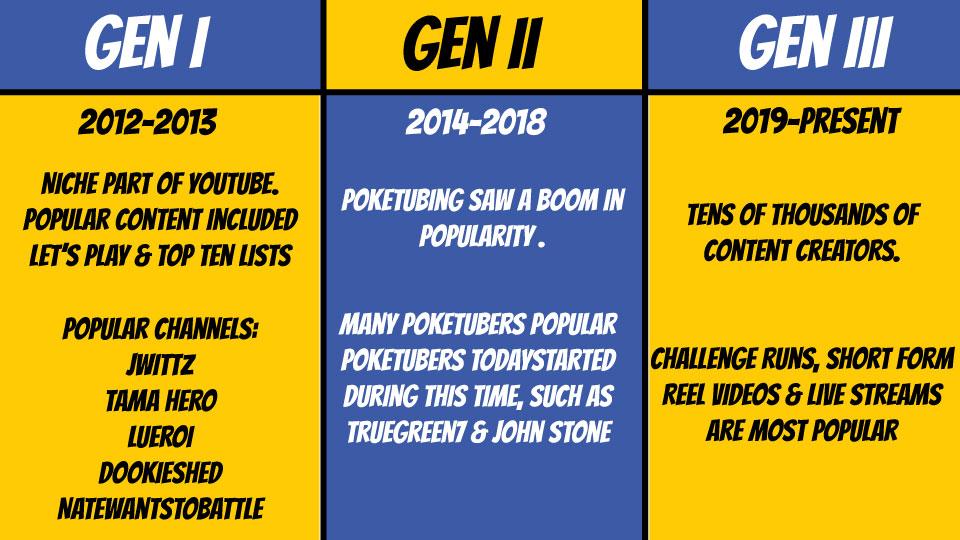
YouTuber Ron Sroor, who runs the channel Truegreen7, said the PokéTube landscape can be divided into three generations characterized by the most popular content from each: Gen I from 2012-2013, Gen II from 2014-2018 and Gen III from 2019-present.
Generation I: Birth of PokéTubing
The first-ever video about “Pokémon” was uploaded to YouTube on Aug. 12, 2005, six months after the site was created. Before Gen I PokéTubing started, Sroor said this era was “beta PokéTubing” where most videos were “Let’s Play” videos — a video series documenting the playthrough of a game.
An individual plays “Pokémon Emerald” in the first Pokémon uploaded to YouTube on Aug. 12, 2005. YouTuber Ron Sroor said PokéTubing wouldn’t begin until 2012.
Marriland — who posted videos from 2007-2010 before taking a hiatus until 2012 — and Lueori — who’s “Let’s Play” videos from around 2010 have from hundreds of thousands to a million views — were two big names from pre-Gen I, according to their channels.
Then around 2012-2013, Sroor said PokéTubers such as TheJWittz, Tamashii Hiroka — now Tama Hero —, NateWantsToBattle — now Give Heart Records — and dookieshed among a few others formed the first generation of PokéTubers. “Let’s Plays” remained popular, but another type of content became just as popular — the top 10 videos.
“Once the first generation hit it was mostly top 10s,” Sroor said. “Almost every video in the first generation of coping tubing was either playthrough or top 10 or what’s it called a fact video — fact videos were huge back then.”
YouTube videos could only be 10 minutes, until 2010 when they extended the time limit to 15 minutes, before removing limits altogether later that year, according to Tech Crunch. YouTuber Josh Rosenberg, who runs the channel Jrose11, said even with these limits removed, for years after 10-15 minute long videos were still the most popular, which was part of the reason “Let’s Plays” and top 10s were so popular.
Wittenkeller said he started posting videos solely about the Pokémon Trading Card Game before transitioning into broader “Pokémon” content of top 10 lists and his “Pokémon Fact of The Day” series. Of his 20 most viewed videos, 15 are either a top 10 video or fact of the day video posted in 2012 or 2013, and four of the top six are top 10s, such as his “Top 10 Worst Poké Balls” with 10 million views.
“There are people who know my videos better than I do, which is kind of crazy to me,” Wittenkeller said. “When it’s been this long and you’ve made 500-600 individual pieces of content it’s hard to remember everything. But for every one of those videos, it may have been somebody else’s favorite. So it is just funny, your works always becomes something that’s greater than just yourself.”
YouTuber Josh Wittenkeller counts down his 10 worst pokéballs in a video uploaded June 28, 2013. This is his second most viewed video with 10 million views.
Tama Hero and dookieshed each also had top 10 videos during this time with at least a million views, such as each of their top 10 favorite “Pokémon” videos, according to their channels. For “Let’s Plays,” PurpleRodri had many videos from this period that now have over a million views and Marriland remained popular after coming back.
Multiple sources said something different about Gen I PokéTubing was it was a small niche community as these PokéTubers were among the few channels regularly posting “Pokémon” content.
“It was easily less than 50 people making regular YouTube “Pokémon” content it felt like when I started,” Wittenkeller said. “Now it’s probably more than 10,000.”
Generation II: The X & Y Boom
The sixth generation of “Pokémon,” “Pokémon X & Y” were the first 3D games of the series and released Oct. 12, 2013, according to Pokémon’s website. Multiple sources said starting after these games were released, the following years saw an influx of people start making “Pokémon” content, where the landscape went from this smaller niche to large community.
Wittenkeller said part of the reason for this influx of people becoming PokéTubers was due to trends in YouTube as a whole where across the site more people were joining.
“More people were becoming aware of YouTube and making content on YouTube,” Wittenkeller said. “The barrier to entry was a lot lower. It’s a lot easier to have a microphone that didn’t sound terrible and didn’t cost a fortune; [a] video webcam that looked good enough and didn’t cost a fortune.”
Sroor said watching the Gen I PokéTubers inspired him to become one himself and he posted his first video Nov. 3, 2013 — a top 10 of his favorite Pokémon from “X & Y.” He would continue to post top 10 videos for the next few years.
Throughout the next few years, other PokéTubers who have gone on to make a large name for themselves started posting videos during this time such as John Stone, Austin John Plays, Pikasprey and WolfeyVGC among many others, according to each of their channels.
“Some people are getting back into “Pokémon” because of “Pokemon Go,” or because of the newest generations — generation six and seven — so then now you have an influx of a lot of PokéTubers,” Sroor said. “Some are old fans, some are new fans.”
During Gen II of PokéTubing, multiple sources said many of the videos started being more heavily edited compared to Gen I.
“[PokéTube] was kind of more like, here’s some pictures, or here’s some gameplay with some audio over the top,” said YouTuber Toby Rivers, who runs the channel Lore Keeper Toby, in a March 11 video he sent to the Graphic. “It was around the time I was coming in that people were starting to use their face camera.”
The “Let’s Plays” and top 10s were popular during Gen II, but toward the end of this generation, the type of content which was popular started to shift.
Challenge runs — playing through a “Pokémon” game with self imposed challenges to make the game more difficult — became popular around 2018-2019. Rosenberg said he created one of these videos Aug. 25, 2018 when he uploaded a video of him playing through Pokémon Red with only a Magikarp. Seven years later, it is his most viewed video with 5.8 million views.
“That’s been the fundamental change,” Rosenberg said. “Where it went from lore oriented to challenge oriented.”
YouTuber Josh Rosenberg plays through “Pokémon Red” using only a Magikarp in a video uploaded Aug. 25, 2018. This is his most viewed video with 5.8 million views.
Pikasprey uploaded a video in February 2018 of him beating “Pokémon Red” with only a Ditto, which has 5.9 million views, according to his channel. The YouTuber Mah-Dry-Bread has been uploading challenge runs consistently since 2019. While he uploads many other types of content as well, of his top 20 most viewed videos, 17 of them are challenge runs posted in either 2019 or 2020, each with over a million views.
A couple other examples include John Stone’s Professor Oak’s Challenge and catching every Pokémon in 24 hours videos, which each have millions of views, according to his channel. This type of content has remained some of the most popular in the landscape.
“There was a little bump before the pandemic, and then during there’s a huge bump within the year or two of like, the massive titans of modern YouTubers YouTube emerging because people have — because of the pandemic — flocked to YouTube, and they never left,” Rosenberg said. “And they’re just hungry for that kind of content, and people were more than happy to fill the gaps.”
Generation III: Professionalization of YouTube
While at the start of PokéTubing 10 to 15 minutes reigned supreme, today’s audience wants something different. Multiple sources said the PokéTube audience wants longer form videos. The audience is no longer interested in watching a “Let’s Play” with 20 episodes, each 15 minutes, rather they want a video anywhere from 30 minutes to multiple hours long.
For example, SmallAnt’s challenge runs — which can range from 30 minutes to over an hour — are some of the most popular videos in the landscape with some having over 10 million views, according to his channel.
“The sweet spot has gone from 10 minutes to 40 minutes,” Rosenberg said. “I remember my Magikarp video was 40 minutes — like, ‘Whoa. This is long.’ Now adef will regularly release videos that are an hour [and] 50 minutes, and they have hundreds of thousands of views.”

Infographic by Tony Gleason
Rosenberg said YouTube has replaced TV for peoples primary source of entertainment, which partially explains why the audience wants longer videos. Furthermore, Twitch and live streaming has also replaced the need for “Let’s Plays.”
“What we’re seeing is the professionalization of YouTube because Twitch has sort of taken over that space,” Rosenberg said. “If you want to watch SmallAnt let’s play his challenges, you can go and follow him on Twitch and watch that. But when you get SmallAnt on YouTube, you’re getting a curated 30 to 40 minute professional voiceover with some live stuff mixed in for atmosphere.”
While challenge runs are some of the most popular videos of the PokéTube landscape, they are still just one piece of the puzzle, as the size of PokéTube has grown to the point where it’s impossible to know everyone. Rosenberg — who has over 300,000 subscribers — said he’s met people who watch “Pokémon” videos who have never heard of him.
Wittenkeller said the landscape is now made up of a bunch of smaller categories that create similar content, without much interaction between communities who focus on different content.
“You have people It’s become so big that you don’t know everybody anymore, and so all you can really do is like what you love the most and connect with other people that are doing the same,” Wittenkeller said.
__________________
Follow the Graphic on X @PeppGraphic
Contact Tony Gleason via email: anthony.gleason@pepperdine.edu or Instagram: @tonygleasonjournalist