
Editor’s Note: Melissa Houston was a member of Dance In Flight (DIF) this past year.
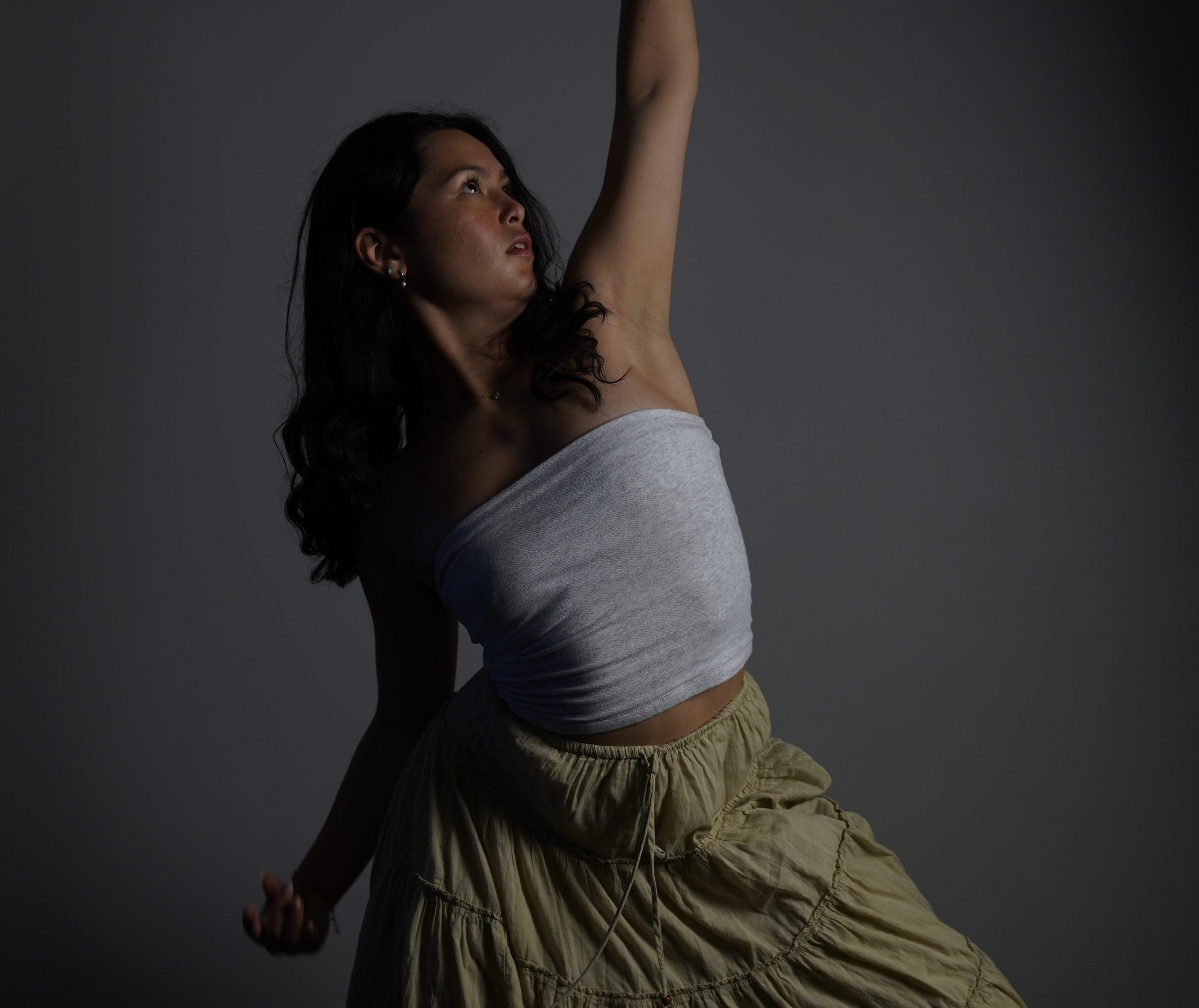
Isabelle Ignacio’s dances for the camera. She said her dancing reflects the individuality behind every performance. Photo by Melissa Houston.
The lights come up, the curtain rises and the show begins.
From the outside, performing all looks the same. People go on stage, move, sing, dance and execute something they have practiced over and over again.
But behind every performance is a human being bringing an experience to the stage that is unique to them and makes the moment theirs.
“With any performance, you have the chance to become somebody else or to embody something else,” said Jaycee Cox, senior dancer at Pepperdine. “I feel like, in a sense, I do feel more connected with my own self too.”
Performing for Emotion
For Cox, a member of Dance in Flight (DIF), she said her performance career started when she was young and continued into college. Performing had begun long before an audience was in front of her.
“Dancing to dance, even with no audience, I feel it even more deeply because it feels more personal,” Cox said.
Dance is internal — Cox said it’s a way to process emotions that don’t always have clear words or explanations. After stressful days, dance becomes a release and something that allows her to let go of what she is holding onto.
“Sometimes I’ll come in [to the studio], and I’m like ‘I’ve had such a bad day,’ but then after I dance, I feel a lot more free because I got to let that out,” Cox said.
Even on stage, that feeling remains the same for her.
During a show last year, Cox performed to “Silver Springs” by Fleetwood Mac and said she didn’t just dance, but she embodied the music. She described the feeling she had as fully stepping into the role of Stevie Nicks and becoming her emotions in the song.
“I felt her words and I felt like I was embodying her in that moment and taking on whatever emotions and frustrations that she felt,” Cox said.
For Cox, she said performing is not about recognition, but rather helping audience members resonate with the emotions she tries to convey.
“I perform because it gives me the power to share my own thoughts and emotions, and I always leave hoping somebody in the audience feels seen,” Cox said.
Performing for Expression
For dancer Genevieve Velarde, senior at Pepperdine and fellow member of DIF, she said performance is less defined.
Her relationship with dance has never been linear. There were moments such as when she did not make her high school dance team. She said she questioned the reason and then eventually came back to performing in college.
“When I think back to the times where I wasn’t dancing, I was always missing it,” Velarde said. “I guess I just couldn’t find anything else to fill that void of expression.”
But even that sense of expression is still something Velarde said she is trying to figure out.
“I am trying to find that still,” Velarde said. “That is what is keeping my passion alive; I’m still on that search.”
Velarde’s relationship with performance is shaped by the exploration of her emotions. She said it is not a fixed feeling, but rather something that she is still discovering.
“I love performing because it gives me a voice when I don’t know the right thing to say,” Verlarde said.
Through her movement, she said she is able to communicate in a different language — one that doesn’t require words.
“Expressing myself through nonverbal activities — like dance or music — is how I feel the most comfortable,” Velarde said.
And for Velarde, she said her performances are not defined by who is watching but rather by what it gives her personally.
“I would still dance if I knew no one was looking at me because I do that anyways,” Velarde said. “Performing is not about the people, it’s literally just for you.”
Performing in Vulnerability
Zoe O’Donnell, Musical Theatre major and senior at Pepperdine, said she approaches performances differently than Velarde and Cox.
O’Donnell said she feels like her truest self when on stage, as she is constantly learning how to blend her character with herself.
“‘What am I feeling, what am I processing or what am I doing in this moment as my character?’” O’Donnell said. “A lot of this is how can I melt them both together so that way I’m not pulling out of the show.”
That process does not end when she leaves the stage. O’Donnell said she usually finds herself reflecting after her performance — separating her own emotions with the ones she carried on stage.
“When the show ends, that’s when I can finally process my own emotions,” O’Donnell said. “And I’m able to step back and realize how it went.”
The senior uses her performances as a way to understand her own emotions and learn more about herself.
O’Donnell said she usually finds out more about herself than the character she is portraying.
That self-awareness comes from a deeper part of her performance — vulnerability.
O’Donnell said learning how to be vulnerable and how much of herself to give on stage has been one of the most challenging parts of her performances.
“It’s about being vulnerable — that’s how you connect with people watching you,” O’Donnell said.
Balancing vulnerability with performing is not always easy. She said there is always this pressure she feels before she steps onto the stage — her desire to perform well, to be liked and to meet the expectations of her teachers, peers and family.
“But then you have to remind yourself that this is what you love,” O’Donnell said.
Although Cox, Velarde and O’Donnell all step onto the same Smothers stage to perform, their internal experiences are completely different.
For Cox, performance is a way to release her emotions. For Velarde, it is a tool to help her express what is hard to say out loud. For O’Donnell, it is about stepping into another life and sharing that experience with others.
From the audience’s perspective, none of it is visible. All they see is the performance.
But behind every move, song and dance, there is something even deeper happening — something unseen and personal to each performer.
“And though that is not stage-ready performances, I still feel the most comfortable and most authentic when I’m either dancing at a wedding or a party or on stage,” Velarde said. “I think that there are different definitions of performing.”
________________
Follow the Graphic on X: @PeppGraphic
Contact Melissa Houston via email: Melissa.houston@pepperdine.edu or via Instagram: @melissahoustonmedia